The Irish Merediths
Meredith families who settled in Ireland and their descendants
Person Page 58
Susanna Meredith 1
1
F, #1426, b. 5 May 1843, d. 19 July 1895
Parents
| Father | Thomas Meredith b. ca. 1812, d. 4 Apr 1885 |
| Mother | Mary Meredith b. ca. 1809, d. 15 Aug 1875 |
Biography

Susanna Meredith was born on 5 May 1843 in Queen's Co., IrelandG. She was baptised on 20 Oct 1843 in Ballyfin, Clonenagh Parish, Mountrath.2 She and Abraham Thompson were married on 27 Mar 1871 in St Peter’s Church, DublinG. She died on 19 Jul 1895, at age 52, in Cappagh, Queen's County, Ireland.3
Family
Children with Abraham Thompson b. ca. 1837, d. 23 Feb 1923
| 1. | Daughter | Mary Jane Thompson b. 1872 |
| 2. | Daughter | Rebecca Ann Thompson b. 15 Feb 1875 |
| 3. | Daughter | Esther Elizabeth Thompson b. 6 Dec 1876, d. 1943 |
| 4. | Son | Thomas Thompson b. 1 Jun 1878 |
| 5. | Son | Robert William Thompson b. 12 Aug 1880 |
| 6. | Son | Samuel Thompson b. 13 Apr 1882 |
| 7. | Son | Abraham Thompson b. 2 Mar 1885 |
| 8. | Daughter | Marian Susan Thompson b. 27 Feb 1887 |
Connections
| Family Line | Clonenagh Merediths |
| Relationship | 2nd great-granddaughter of Rice Meredith 3rd great-niece of Mathias Meredith |
| Ancestral line | MaryD, JohnC, Early Clonenagh MeredithsB, Rice MeredithA |
| Ancestral line | MaryC, JohnB, Early Clonenagh MeredithsA |
| Lists | Clonenagh Merediths |
TIMELINE: Year Age
- 1843Birth:5 May 1843 | Queen's Co., IrelandG
- 187127Marriage: | Abraham Thompson27 Mar 1871 | St Peter’s Church, DublinG
- 1872~29Her daughter Mary Jane Thompson was born in 1872.
- 187531Her daughter Rebecca Ann Thompson was born on 15 Feb 1875 in Cappagh, Queen's County, Ireland.
- 187532Her mother Mary Meredith died on 15 Aug 1875 in The Oak, Queen's County, IrelandG.
- 187633Her daughter Esther Elizabeth Thompson was born on 6 Dec 1876 in Ireland.
- 187835Her son Thomas Thompson was born on 1 Jun 1878 in Cappa, Queen’s Co., Ireland.
- 188037Her son Robert William Thompson was born on 12 Aug 1880 in Cappagh, Co. Laois, IrelandG.
- 188238Her son Samuel Thompson was born on 13 Apr 1882 in Cappagh, Co. Laois, IrelandG.
- 188541Her son Abraham Thompson was born on 2 Mar 1885 in Cappa, Queen’s Co., Ireland.
- 188541Her father Thomas Meredith died on 4 Apr 1885 in The Oak, Queen's Co., Ireland.
- 188743Her daughter Marian Susan Thompson was born on 27 Feb 1887 in Cappagh, Co. Laois, IrelandG.
- 189552Death:19 Jul 1895 | Cappagh, Queen's County, Ireland
- 1923Her husband Abraham Thompson died on 23 Feb 1923 in Ballyfin, Queens County, IrelandG.
Citations
- [S383] Sharon Haggerty, Website: Haggerty Ancestors and Related Families, http://winters-online.net/sharon-haggerty-db/
- [S465] Parish register
- [S1462] Irish Civil Records of Births, Marriages and Deaths, database: https://civilrecords.irishgenealogy.ie/
| Last Edited | 23 Apr 2017 |
John Meredith
M, #1427, b. 28 January 1845
Parents
| Father | Thomas Meredith b. ca. 1812, d. 4 Apr 1885 |
| Mother | Mary Meredith b. ca. 1809, d. 15 Aug 1875 |
Biography

John Meredith was born on 28 Jan 1845 in Queen's Co., IrelandG. He was baptised on 30 Mar 1845 in Ballyfin, Clonenagh Parish, Mountrath.1
For further information see the citations below.2
Connections
| Family Line | Clonenagh Merediths |
| Relationship | 2nd great-grandson of Rice Meredith 3rd great-nephew of Mathias Meredith |
| Ancestral line | MaryD, JohnC, Early Clonenagh MeredithsB, Rice MeredithA |
| Ancestral line | MaryC, JohnB, Early Clonenagh MeredithsA |
| Lists | Clonenagh Merediths |
TIMELINE: Year Age
- 1845Birth:28 Jan 1845 | Queen's Co., IrelandG
- 187530His mother Mary Meredith died on 15 Aug 1875 in The Oak, Queen's County, IrelandG.
- 188540His father Thomas Meredith died on 4 Apr 1885 in The Oak, Queen's Co., Ireland.
Citations
- [S465] Parish register
- [S383] Sharon Haggerty, Website: Haggerty Ancestors and Related Families, http://winters-online.net/sharon-haggerty-db/
| Last Edited | 26 Jan 2004 |
Samuel Meredith1
M, #1428, b. 16 October 1846, d. 21 June 1901
Parents
| Father | Thomas Meredith b. ca. 1812, d. 4 Apr 1885 |
| Mother | Mary Meredith b. ca. 1809, d. 15 Aug 1875 |
Biography
Samuel Meredith was born on 16 Oct 1846 in The Oak, Queen's County, IrelandG. He was baptised on 6 Dec 1846 in Ballyfin, Clonenagh Parish, Mountrath.2 He and Caroline Wilkinson were married on 6 Aug 1885 in Ballintubber Parish Church, Queen’s Co.3 He died on 21 Jun 1901, at age 54, in Omoresforest, Queen’s Co., IrelandG.4 He was buried on 23 Jun 1901 in Maryborough, Queen's Co., IrelandG.2
Samuel and his two daughters were living in Omoresforest for the 1901 census. His age was said to be 52, and he was a widower and farmer at the time.
Family
Children with Caroline Wilkinson b. ca. 1863, d. 20 Jan 1893
| 1. | Daughter | Mary Matilda Meredith b. 20 Jun 1887, d. 20 Jun 1972 |
| 2. | Daughter | Elizabeth Meredith b. 18 Nov 1889 |
| 3. | Son | Thomas Meredith b. 13 Jan 1893 |
Connections
| Family Line | Clonenagh Merediths |
| Relationship | 2nd great-grandson of Rice Meredith 3rd great-nephew of Mathias Meredith |
| Ancestral line | MaryD, JohnC, Early Clonenagh MeredithsB, Rice MeredithA |
| Ancestral line | MaryC, JohnB, Early Clonenagh MeredithsA |
| Lists | Clonenagh Merediths |
TIMELINE: Year Age
- 1846Birth:16 Oct 1846 | The Oak, Queen's County, IrelandG
- 187528His mother Mary Meredith died on 15 Aug 1875 in The Oak, Queen's County, IrelandG.
- 188538His father Thomas Meredith died on 4 Apr 1885 in The Oak, Queen's Co., Ireland.
- 188538
- 188740His daughter Mary Matilda Meredith was born on 20 Jun 1887 in The Oak, Queen's County, IrelandG.
- 188943His daughter Elizabeth Meredith was born on 18 Nov 1889 in The Oak, Queen's County, IrelandG.
- 189346His son Thomas Meredith was born on 13 Jan 1893 in The Oak, Queen's County, IrelandG.
- 189346His wife Caroline Wilkinson died on 20 Jan 1893 in The Oak, Queen's County, IrelandG.
- 190154Death:21 Jun 1901 | Omoresforest, Queen’s Co., IrelandG
- 1901Burial:23 Jun 1901 | Maryborough, Queen's Co., IrelandG
Citations
- [S383] Sharon Haggerty, Website: Haggerty Ancestors and Related Families, http://winters-online.net/sharon-haggerty-db/
- [S465] Parish register
- [S1343] Marriage certificate of Samuel Meredith and Caroline Wilkinson, 6 August 1885; copy in the possession of the author
- [S1462] Irish Civil Records of Births, Marriages and Deaths, database: https://civilrecords.irishgenealogy.ie/
| Last Edited | 23 Apr 2017 |
Esther Meredith1
F, #1429, b. 8 April 1849, d. 16 February 1887
Parents
| Father | Thomas Meredith b. ca. 1812, d. 4 Apr 1885 |
| Mother | Mary Meredith b. ca. 1809, d. 15 Aug 1875 |
Biography
Esther Meredith was born on 8 Apr 1849 in The Oak, Queen's County, IrelandG. She was baptised on 30 Sep 1849 in Ballyfin, Clonenagh Parish, Mountrath.2 She and Richard Thompson were married on 7 Sep 1875 in Mountrath Parish, Queen’s Co., Ireland.3 She died on 16 Feb 1887, at age 37, in Shrahane, Queen’s Co.3
Family
Children with Richard Thompson b. ca. 1845, d. 27 Aug 1901
| 1. | Son | Joseph Thompson b. 22 Nov 1876 |
| 2. | Daughter | Mary Ellen Thompson b. 6 Apr 1878 |
| 3. | Son | Thomas Thompson b. 13 Sep 1879 |
| 4. | Daughter | Lydia Thompson b. 19 Aug 1881 |
Connections
| Family Line | Clonenagh Merediths |
| Relationship | 2nd great-granddaughter of Rice Meredith 3rd great-niece of Mathias Meredith |
| Ancestral line | MaryD, JohnC, Early Clonenagh MeredithsB, Rice MeredithA |
| Ancestral line | MaryC, JohnB, Early Clonenagh MeredithsA |
| Lists | Clonenagh Merediths |
TIMELINE: Year Age
- 1849Birth:8 Apr 1849 | The Oak, Queen's County, IrelandG
- 187526Her mother Mary Meredith died on 15 Aug 1875 in The Oak, Queen's County, IrelandG.
- 187526
- 187627Her son Joseph Thompson was born on 22 Nov 1876 in Strahanboy, Queen’s Co., Ireland.
- 187828Her daughter Mary Ellen Thompson was born on 6 Apr 1878 in Shrahanboy, Queen’s Co..
- 187930Her son Thomas Thompson was born on 13 Sep 1879 in Shahanboy, Queen’s Co., Ireland.
- 188132Her daughter Lydia Thompson was born on 19 Aug 1881 in Shrahane, Queen’s Co.
- 188535Her father Thomas Meredith died on 4 Apr 1885 in The Oak, Queen's Co., Ireland.
- 188737Death:16 Feb 1887 | Shrahane, Queen’s Co
- 1901Her husband Richard Thompson died on 27 Aug 1901 in Srahane, Queen’s Co..
Citations
- [S383] Sharon Haggerty, Website: Haggerty Ancestors and Related Families, http://winters-online.net/sharon-haggerty-db/
- [S465] Parish register
- [S1462] Irish Civil Records of Births, Marriages and Deaths, database: https://civilrecords.irishgenealogy.ie/
| Last Edited | 11 Sep 2018 |
Charles Henry Meredith1
M, #1430, b. 6 March 1858, d. 1 October 1920
Parents
| Father | Edward Meredith b. ca. 1832, d. 6 Oct 1892 |
| Mother | Susanna Moore b. ca. 1837, d. 15 Oct 1889 |
Biography
Charles Henry Meredith was born on 6 Mar 1858 in Queen's Co., IrelandG.2 He and Jane Young were married on 5 Dec 1889 in St. James’s Church, DublinG.3 He died on 1 Oct 1920, at age 62, in Paulville, Co. Carlow, IrelandG.3
Charles Henry Meredith was a Constable in the Royal Irish Constabulary. He enlisted aged 25 and served in Mayo from Nov 1883 and in the Reserve from Nov 1887. In 1907 he was the Depot van driver at the R.I.C. Depot in Dublin. He received a pension in 1907 afted 25 years service.
Family
Children with Jane Young b. ca. 1863, d. 5 Dec 1931
| 1. | Son | Edward Myles Meredith b. ca. 1893, d. 13 Apr 1918 |
| 2. | Son | Charles Henry Meredith b. 1897, d. 16 May 1902 |
Connections
| Family Line | Clonenagh Merediths |
| Relationship | 3rd great-grandson of Rice Meredith 4th great-nephew of Mathias Meredith |
| Ancestral line | EdwardE, ThomasD, JohnC, Early Clonenagh MeredithsB, Rice MeredithA |
| Ancestral line | EdwardD, ThomasC, JohnB, Early Clonenagh MeredithsA |
| Lists | Clonenagh Merediths |
TIMELINE: Year Age
- 1858Birth:6 Mar 1858 | Queen's Co., IrelandG
- 188931His mother Susanna Moore died on 15 Oct 1889 in Springfield, Co. Laois.
- 188931Marriage: | Jane Young5 Dec 1889 | St. James’s Church, DublinGAge: ~26Birth: ca. 1863 | Co. CarlowDeath: on 5 Dec 1931 | Rathnafishogue, Co. Carlow, Ireland
- 189234His father Edward Meredith died on 6 Oct 1892 in Springfield, Co. Laois.
- 1893~35His son Edward Myles Meredith was born ca. 1893 in Dublin CityG.
- 1897~39His son Charles Henry Meredith was born in 1897 in Dublin CityG.
- 190244His son Charles Henry Meredith died on 16 May 1902 in R.I.C. Depot, Dublin.
- 191860His son Edward Myles Meredith died on 13 Apr 1918 in Belgium.
- 192062Death:1 Oct 1920 | Paulville, Co. Carlow, IrelandG
- 1931His wife Jane Young died on 5 Dec 1931 in Rathnafishogue, Co. Carlow, Ireland.
Citations
- [S383] Sharon Haggerty, Website: Haggerty Ancestors and Related Families, http://winters-online.net/sharon-haggerty-db/
- [S465] Parish register
- [S1462] Irish Civil Records of Births, Marriages and Deaths, database: https://civilrecords.irishgenealogy.ie/
| Last Edited | 13 Feb 2018 |
Richard Meredith1,2
M, #1431, b. about 1792, d. 3 June 1850
Parents
| Father | Samuel Meredith b. ca. 1756, d. Jul 1832 |
| Mother | Sarah Ince b. ca. 1761, d. Jan 1826 |
Biography
Richard Meredith was born ca. 1792 in Cappagh, Queen's county, Ireland. He and Anne Greene were married in 1819 in Dublin, IrelandG. He died on 3 Jun 1850, at age ~58, in New YorkG. He was buried in Greenwood Cemetery, Brooklyn, NYG.
Family history is that Richard Meredith was from Cappagh, Queen's county, and immigrated to New York in the late 1840s. If so, naming patterns of his children suggest he may have been a son of Samuel Meredith and Sarah Ince of Cappagh, although we have no documentation to support this. He appears to have lived in Lea parish, Portarlington from 1820 to 1830, according to baptism records for six children from St. Paul's Church. There are baptisms for two younger children in Maryborough Methodist records.
There is an account of Richard Meredith and Anne Greene’s courtship, as well as other details of the Greene family, in the book "Family History of Richard Greene" published in 1909, and available online.3
There is an account of Richard Meredith and Anne Greene’s courtship, as well as other details of the Greene family, in the book "Family History of Richard Greene" published in 1909, and available online.3
Family
Children with Anne Greene b. 4 Apr 1799, d. 29 Jun 1856
| 1. | Daughter | Ann Meredith b. ca. 1820 |
| 2. | Son | Rev. Samuel James Meredith b. 1 Mar 1820, d. 16 Dec 1894 |
| 3. | Daughter | Sarah Meredith b. Sep 1822, d. 19 Jan 1876 |
| 4. | Daughter | Jane G. Meredith b. 30 Jan 1825, d. 14 Jun 1901 |
| 5. | Daughter | Maria Meredith b. 14 Mar 1827 |
| 6. | Daughter | Elizabeth Meredith b. 1829 |
| 7. | Daughter | Fanny Meredith b. ca. 1830 |
| 8. | Son | John William Meredith b. 9 Aug 1830 |
| 9. | Son | Rev. Richard Meredith b. 13 May 1833, d. 5 Jul 1904 |
| 10. | Son | Frederick Agustus Meredith b. ca. 1835 |
| 11. | Son | Rev. Robert Rhoden Meredith b. 8 Feb 1836, d. 25 Nov 1919 |
| 12. | Daughter | Charlotte Meredith b. 7 Dec 1838, d. 24 Oct 1911 |
| 13. | Daughter | Emily Louise Meredith b. 30 Oct 1841, d. aft. 1920 |
Connections
| Family Line | Clonenagh Merediths |
| Relationship | Great-grandson of Rice Meredith 2nd great-nephew of Mathias Meredith |
| Ancestral line | SamuelC, Early Clonenagh MeredithsB, Rice MeredithA |
| Ancestral line | SamuelB, Early Clonenagh MeredithsA |
| Lists | Clonenagh Emigration Clonenagh Merediths |
| Charts | Clonenagh box chart Clonenagh indented chart Rearymore box chart Rearymore indented chart |
| Interactive Pedigree |
TIMELINE: Year Age
- 1792Birth:Ca. 1792 | Cappagh, Queen's county, Ireland
- 1819~27Marriage: | Anne Greene1819 | Dublin, IrelandGAge: ~20Birth: on 4 Apr 1799 | Pinnock Hill, Swords, IrelandDeath: on 29 Jun 1856 | Brooklyn, New YorkG
- 1820~28His daughter Ann Meredith was born ca. 1820 in Ireland.
- 1820~28His son Rev. Samuel James Meredith was born on 1 Mar 1820 in Ireland.
- 1822~30His daughter Sarah Meredith was born in Sep 1822 in Ireland.
- 1825~33His daughter Jane G. Meredith was born on 30 Jan 1825 in Ireland.
- 1826~34His mother Sarah Ince died in Jan 1826 in Queen's Co., IrelandG.
- 1827~35His daughter Maria Meredith was born on 14 Mar 1827 in Ireland.
- 1829~37His daughter Elizabeth Meredith was born in 1829 in Ireland.
- 1830~38His daughter Fanny Meredith was born ca. 1830 in Ireland.
- 1830~38His son John William Meredith was born on 9 Aug 1830 in Ireland.
- 1832~40His father Samuel Meredith died in Jul 1832 in Queen's Co., IrelandG.
- 1833~41His son Rev. Richard Meredith was born on 13 May 1833 in Ballybrittas, IrelandG.
- 1835~43His son Frederick Agustus Meredith was born ca. 1835 in Ireland.
- 1836~44His son Rev. Robert Rhoden Meredith was born on 8 Feb 1836 in Maryborough, Queen's Co., IrelandG.
- 1838~46His daughter Charlotte Meredith was born on 7 Dec 1838 in Queen's Co., IrelandG.
- 1841~49His daughter Emily Louise Meredith was born on 30 Oct 1841 in Maryborough, Queen's Co., IrelandG.
- 1850~58Death:3 Jun 1850 | New YorkG
- 1856His wife Anne Greene died on 29 Jun 1856 in Brooklyn, New YorkG.
Citations
- [S400] Private communication from Ian Meredith
- [S383] Sharon Haggerty, Website: Haggerty Ancestors and Related Families, http://winters-online.net/sharon-haggerty-db/
- [S2290] "Family History of Richard Greene" (1909); available online at: https://static.torontopubliclibrary.ca/da/pdfs/historicalfactsi00greeuoft.pdf
| Last Edited | 22 Nov 2025 |
Anne Greene1,2
F, #1432, b. 4 April 1799, d. 29 June 1856
Parents
| Father | John Greene |
Biography
Anne Greene was born on 4 Apr 1799 in Pinnock Hill, Swords, Ireland. She and Richard Meredith were married in 1819 in Dublin, IrelandG. She died on 29 Jun 1856, at age 57, in Brooklyn, New YorkG.
She is most likely to be the Ann Meredith, aged 50, living with Fanny aged 20 in the household of James and Matilda McKay in Brooklyn in 1850.
A lengthy obituary appeared in the book “Heroines of Methodism”, probably written by her son Rev. Samuel Meredith, as follows:
---START---
MRS. ANN MEREDITH.
Mrs. Ann Meredith, whose maiden name was Green, was born at Penock Hill, near the ancient town of Swords, County Dublin, Ireland, April 4,1799. Though surrounded by great spiritual destitution and a low state of morals, her father's family was known as one in which the Scriptures were read. Like Cornelius they " feared God," and as in his case so in theirs, the Lord sent his servant to "tell them what they ought to do."
A pious man belonging to the Wesleyan Society in the City of Dublin, one who labored for the salvation of souls as he had opportunity, received the impression that he ought to visit Swords; that the Lord had something for him to do there. Followed by this impression until it became fixed in his mind, and under what he now regarded as a Divine call, he and two others visited that place on a Saturday evening. At the public house in which they were staying, they made inquiries next morning, as to the religious condition of Swords and its vicinity, when they ascertained that there was one family, at least, in which the Bible was read, that of " John Green, on the hill."
They called immediately at Mr. Green's residence. The family, with one exception, had not yet risen. That one was his daughter Martha, then graciously disposed and afterward an eminent Christian, whose death was the most remarkably triumphant ever known in that part of the country. She had just been at prayer as the strangers called. In stating their object to her father, she told him that three men, belonging, she thought, to his order, (he was a freemason,) wished to pray with him. They were soon surrounded by Mr. Green and his family, with whom they conversed for some time, and after prayer requested permission to hold a meeting in their house that afternoon. To this Mrs. Green was opposed. She remembered that when she was a little girl Mr. Wesley had preached in Swords, and that the windows of the house in which he stopped were broken by persons who were opposed to the " Swaddlers," (as the Methodists were then called;) and she feared that if they opened their house to these men, similar results would follow. But some of her daughters becoming interested in the object the men proposed, she was induced to give her consent.
In the afternoon these zealous men came up from the town, accompanied by about a dozen individuals whom they had invited to the meeting. One of them preached from, " Fear not, little flock; for it is your Father's good pleasure to give you the kingdom." Everything about this meeting was as novel and striking to the Green family, as its results were permanent and blessed. My uncle, now the only surviving one of those of his family then present, writes concerning it: " The singing entranced us all, and we thought the text, sermon, and all were made on purpose for us." Henceforth Mr. Green's house was open for the messengers of the Gospel, and He whose blessing rested upon the house of Obed-edom, caused it also to abide on his. But a short time passed until several members of his family were brought to God.
The fears entertained by Mrs. Green were fully realized. Their windows were broken frequently, and their lives endangered by the drunken, popish rabble, who were enraged because the Methodists had obtained a footing in the neighborhood. For several years Mr. Green and his family were subjected to the most provoking annoyances. They ceased at length, and then Mrs. Green would repeatedly express her fears that they were not as faithful as when they suffered persecution.
We ought to note, that Mr. Green's household embraced all who were ever known to be benefited savingly by the Gospel thus introduced into the neighborhood, and preached there for several years. To the worldly they alone were known as a family who respected the Bible, and they alone received the greater light when it came.
Mr. Green's daughter Ann, the subject of this notice, was in the fourteenth year of her age when, as an earnest seeker of the Divine favor, she entered the apartment in her father's house in which meeting was about to be held. The opening hymn had been sung, and the little company were engaged in prayer, when she was enabled to cast herself upon Christ for the salvation she needed. In an instant her mourning was turned into joy, and her full soul broke out in joyous and grateful proclamation of the blessed fact that her sins were forgiven. Her mother did not understand it. Such, displays of religious emotion were a new thing in the place, and she endeavored to silence Ann. But if she were to be silent, would not the stones immediately cry out? Some short time afterward she united with the Wesleyan society, in which she found a religious home until she came to this country, in 1847, when she united by letter with the Methodist Episcopal Church. She was an intelligent and ardent lover of Methodism. Her attendance upon its ministry and ordinances was regular and punctual, and of its prudential means she early formed, and ever maintained, the highest estimate.
She was one of those Christians who, though decided in their devotion to God, yet from their exalted views of the Christian life, and from their humbling views of themselves, are seldom found referring to their spiritual progress. But if her professions were, as we believe, too modest—if in this she failed to make the impression she should have made— there was in her life a uniform and definite testimony in favor of religion, that was felt by those who came within the range of her influence. One who knew her many years writes concerning her, " I don't know any person who bore the same deep impress of Christian character she did, nor whose life was so consistent with her profession."
Her maternal influence was directly calculated to awaken in the minds of her children those realizations which lead the soul to God; and it was her joy to find them nearly all, and early in life, giving themselves up to Him. We call her blessed. We saw her spirit in all of the many ordeals through which she passed. We were observers of her secret religious engagements since we were capable of noticing such things. Long as I remember (and I am her first born) she used to spend a portion of every evening in the sacred engagement of private devotion. Nor were these cold and formal approaches to the throne of grace. I have frequently heard her agonizing but subdued pleadings when in an adjoining room; and many a time have I seen her come out from her room, at those times, with her eyes bathed in tears, showing that hers was no fruitless waiting on God. I remember well how she would sit at the parlor fire with two or three of us around her, just between day and dark, and there talk to us of God and judgment, and of the importance of being good that we might all be together in heaven. Once we were talking with her something about Christians, when, to my great surprise, (I never forgot it,) she told me that not all who professed to be Christians were prepared for heaven, and tried to show me the difference between the form and the power of godliness. It was her aim to educate and render duly sensitive the consciences of her children. I did something that was evil in itself as well as disobedient to her. It was in the earlier part of the day, but at night, when an opportunity served, she took me round to a school room, and there, in the dark and alone, she pointed out the nature and consequences of my conduct; and when I was humbled and penitent, she knelt down and pleaded with God in my behalf. The effect was powerful upon my mind, though I suppose the change in my conduct was far from showing it.
It pleased her heavenly Father, before taking her to himself, to cause her to pass through some four months' severe suffering. But in all she manifested a cheerful submission to his will. To her leader she said, " The greatest desire of my heart is that the will of the Lord be done." For several weeks previous to her release it did not appear that Satan was permitted to tempt her. She was as free from doubt, therefore, as from murmuring. In an unmolested confidence, and with a grateful submission, did she wait the coming of her Lord. She took great delight in having those around her, and those who visited her, sing. At times when her favorite hymns were sung, she seemed to be filled with delight . On one occasion some Christian females were singing for her, when becoming very happy she said,li If I were able I would shout his praise, but I'll praise him in a nobler strain through all eternity." On one occasion she spoke to considerable extent on the plan of salvation and the amplitude of the divine provisions. She quoted the words, " to the uttermost," and having enlarged upon them, added, " He will save me to the uttermost." From that time she sunk gradually until she breathed her last.
Thus on the twenty-ninth of June, 1856, in the fiftyeighth year of her age, did my sainted mother pass from the scenes of earth, to that long sought rest for which, during so large a portion of her life, she labored in the exercise of a Scriptural faith. S. M.
---END---.3
A lengthy obituary appeared in the book “Heroines of Methodism”, probably written by her son Rev. Samuel Meredith, as follows:
---START---
MRS. ANN MEREDITH.
Mrs. Ann Meredith, whose maiden name was Green, was born at Penock Hill, near the ancient town of Swords, County Dublin, Ireland, April 4,1799. Though surrounded by great spiritual destitution and a low state of morals, her father's family was known as one in which the Scriptures were read. Like Cornelius they " feared God," and as in his case so in theirs, the Lord sent his servant to "tell them what they ought to do."
A pious man belonging to the Wesleyan Society in the City of Dublin, one who labored for the salvation of souls as he had opportunity, received the impression that he ought to visit Swords; that the Lord had something for him to do there. Followed by this impression until it became fixed in his mind, and under what he now regarded as a Divine call, he and two others visited that place on a Saturday evening. At the public house in which they were staying, they made inquiries next morning, as to the religious condition of Swords and its vicinity, when they ascertained that there was one family, at least, in which the Bible was read, that of " John Green, on the hill."
They called immediately at Mr. Green's residence. The family, with one exception, had not yet risen. That one was his daughter Martha, then graciously disposed and afterward an eminent Christian, whose death was the most remarkably triumphant ever known in that part of the country. She had just been at prayer as the strangers called. In stating their object to her father, she told him that three men, belonging, she thought, to his order, (he was a freemason,) wished to pray with him. They were soon surrounded by Mr. Green and his family, with whom they conversed for some time, and after prayer requested permission to hold a meeting in their house that afternoon. To this Mrs. Green was opposed. She remembered that when she was a little girl Mr. Wesley had preached in Swords, and that the windows of the house in which he stopped were broken by persons who were opposed to the " Swaddlers," (as the Methodists were then called;) and she feared that if they opened their house to these men, similar results would follow. But some of her daughters becoming interested in the object the men proposed, she was induced to give her consent.
In the afternoon these zealous men came up from the town, accompanied by about a dozen individuals whom they had invited to the meeting. One of them preached from, " Fear not, little flock; for it is your Father's good pleasure to give you the kingdom." Everything about this meeting was as novel and striking to the Green family, as its results were permanent and blessed. My uncle, now the only surviving one of those of his family then present, writes concerning it: " The singing entranced us all, and we thought the text, sermon, and all were made on purpose for us." Henceforth Mr. Green's house was open for the messengers of the Gospel, and He whose blessing rested upon the house of Obed-edom, caused it also to abide on his. But a short time passed until several members of his family were brought to God.
The fears entertained by Mrs. Green were fully realized. Their windows were broken frequently, and their lives endangered by the drunken, popish rabble, who were enraged because the Methodists had obtained a footing in the neighborhood. For several years Mr. Green and his family were subjected to the most provoking annoyances. They ceased at length, and then Mrs. Green would repeatedly express her fears that they were not as faithful as when they suffered persecution.
We ought to note, that Mr. Green's household embraced all who were ever known to be benefited savingly by the Gospel thus introduced into the neighborhood, and preached there for several years. To the worldly they alone were known as a family who respected the Bible, and they alone received the greater light when it came.
Mr. Green's daughter Ann, the subject of this notice, was in the fourteenth year of her age when, as an earnest seeker of the Divine favor, she entered the apartment in her father's house in which meeting was about to be held. The opening hymn had been sung, and the little company were engaged in prayer, when she was enabled to cast herself upon Christ for the salvation she needed. In an instant her mourning was turned into joy, and her full soul broke out in joyous and grateful proclamation of the blessed fact that her sins were forgiven. Her mother did not understand it. Such, displays of religious emotion were a new thing in the place, and she endeavored to silence Ann. But if she were to be silent, would not the stones immediately cry out? Some short time afterward she united with the Wesleyan society, in which she found a religious home until she came to this country, in 1847, when she united by letter with the Methodist Episcopal Church. She was an intelligent and ardent lover of Methodism. Her attendance upon its ministry and ordinances was regular and punctual, and of its prudential means she early formed, and ever maintained, the highest estimate.
She was one of those Christians who, though decided in their devotion to God, yet from their exalted views of the Christian life, and from their humbling views of themselves, are seldom found referring to their spiritual progress. But if her professions were, as we believe, too modest—if in this she failed to make the impression she should have made— there was in her life a uniform and definite testimony in favor of religion, that was felt by those who came within the range of her influence. One who knew her many years writes concerning her, " I don't know any person who bore the same deep impress of Christian character she did, nor whose life was so consistent with her profession."
Her maternal influence was directly calculated to awaken in the minds of her children those realizations which lead the soul to God; and it was her joy to find them nearly all, and early in life, giving themselves up to Him. We call her blessed. We saw her spirit in all of the many ordeals through which she passed. We were observers of her secret religious engagements since we were capable of noticing such things. Long as I remember (and I am her first born) she used to spend a portion of every evening in the sacred engagement of private devotion. Nor were these cold and formal approaches to the throne of grace. I have frequently heard her agonizing but subdued pleadings when in an adjoining room; and many a time have I seen her come out from her room, at those times, with her eyes bathed in tears, showing that hers was no fruitless waiting on God. I remember well how she would sit at the parlor fire with two or three of us around her, just between day and dark, and there talk to us of God and judgment, and of the importance of being good that we might all be together in heaven. Once we were talking with her something about Christians, when, to my great surprise, (I never forgot it,) she told me that not all who professed to be Christians were prepared for heaven, and tried to show me the difference between the form and the power of godliness. It was her aim to educate and render duly sensitive the consciences of her children. I did something that was evil in itself as well as disobedient to her. It was in the earlier part of the day, but at night, when an opportunity served, she took me round to a school room, and there, in the dark and alone, she pointed out the nature and consequences of my conduct; and when I was humbled and penitent, she knelt down and pleaded with God in my behalf. The effect was powerful upon my mind, though I suppose the change in my conduct was far from showing it.
It pleased her heavenly Father, before taking her to himself, to cause her to pass through some four months' severe suffering. But in all she manifested a cheerful submission to his will. To her leader she said, " The greatest desire of my heart is that the will of the Lord be done." For several weeks previous to her release it did not appear that Satan was permitted to tempt her. She was as free from doubt, therefore, as from murmuring. In an unmolested confidence, and with a grateful submission, did she wait the coming of her Lord. She took great delight in having those around her, and those who visited her, sing. At times when her favorite hymns were sung, she seemed to be filled with delight . On one occasion some Christian females were singing for her, when becoming very happy she said,li If I were able I would shout his praise, but I'll praise him in a nobler strain through all eternity." On one occasion she spoke to considerable extent on the plan of salvation and the amplitude of the divine provisions. She quoted the words, " to the uttermost," and having enlarged upon them, added, " He will save me to the uttermost." From that time she sunk gradually until she breathed her last.
Thus on the twenty-ninth of June, 1856, in the fiftyeighth year of her age, did my sainted mother pass from the scenes of earth, to that long sought rest for which, during so large a portion of her life, she labored in the exercise of a Scriptural faith. S. M.
---END---.3
Family
Children with Richard Meredith b. ca. 1792, d. 3 Jun 1850
| 1. | Daughter | Ann Meredith b. ca. 1820 |
| 2. | Son | Rev. Samuel James Meredith b. 1 Mar 1820, d. 16 Dec 1894 |
| 3. | Daughter | Sarah Meredith b. Sep 1822, d. 19 Jan 1876 |
| 4. | Daughter | Jane G. Meredith b. 30 Jan 1825, d. 14 Jun 1901 |
| 5. | Daughter | Maria Meredith b. 14 Mar 1827 |
| 6. | Daughter | Elizabeth Meredith b. 1829 |
| 7. | Daughter | Fanny Meredith b. ca. 1830 |
| 8. | Son | John William Meredith b. 9 Aug 1830 |
| 9. | Son | Rev. Richard Meredith b. 13 May 1833, d. 5 Jul 1904 |
| 10. | Son | Frederick Agustus Meredith b. ca. 1835 |
| 11. | Son | Rev. Robert Rhoden Meredith b. 8 Feb 1836, d. 25 Nov 1919 |
| 12. | Daughter | Charlotte Meredith b. 7 Dec 1838, d. 24 Oct 1911 |
| 13. | Daughter | Emily Louise Meredith b. 30 Oct 1841, d. aft. 1920 |
Connections
| Family Line | Clonenagh Merediths |
| Relationship | Partner of Richard Meredith (great-grandson of Rice Meredith) Partner of Richard Meredith (2nd great-nephew of Mathias Meredith) |
| Lists | Clonenagh Emigration Clonenagh Merediths |
| Charts | Clonenagh box chart Clonenagh indented chart Rearymore box chart Rearymore indented chart |
| Interactive Pedigree |
TIMELINE: Year Age
- 1799Birth:4 Apr 1799 | Pinnock Hill, Swords, Ireland
- 1819~20Marriage: | Richard Meredith1819 | Dublin, IrelandG
- 1820~21Her daughter Ann Meredith was born ca. 1820 in Ireland.
- 182020Her son Rev. Samuel James Meredith was born on 1 Mar 1820 in Ireland.
- 182223Her daughter Sarah Meredith was born in Sep 1822 in Ireland.
- 182525Her daughter Jane G. Meredith was born on 30 Jan 1825 in Ireland.
- 182727Her daughter Maria Meredith was born on 14 Mar 1827 in Ireland.
- 1829~30Her daughter Elizabeth Meredith was born in 1829 in Ireland.
- 1830~31Her daughter Fanny Meredith was born ca. 1830 in Ireland.
- 183031Her son John William Meredith was born on 9 Aug 1830 in Ireland.
- 183334Her son Rev. Richard Meredith was born on 13 May 1833 in Ballybrittas, IrelandG.
- 1835~36Her son Frederick Agustus Meredith was born ca. 1835 in Ireland.
- 183636Her son Rev. Robert Rhoden Meredith was born on 8 Feb 1836 in Maryborough, Queen's Co., IrelandG.
- 183839Her daughter Charlotte Meredith was born on 7 Dec 1838 in Queen's Co., IrelandG.
- 184142Her daughter Emily Louise Meredith was born on 30 Oct 1841 in Maryborough, Queen's Co., IrelandG.
- 185051Her husband Richard Meredith died on 3 Jun 1850 in New YorkG.
- 185657Death:29 Jun 1856 | Brooklyn, New YorkG
Citations
- [S400] Private communication from Ian Meredith
- [S383] Sharon Haggerty, Website: Haggerty Ancestors and Related Families, http://winters-online.net/sharon-haggerty-db/
- [S1576] “Heroines of Methodism: or, Pen and ink sketches of the mothers and daughters ...”, EdGeorge Coles; https://goo.gl/ZnbYTD
| Last Edited | 11 Jan 2024 |
Rev. Samuel James Meredith1
M, #1433, b. 1 March 1820, d. 16 December 1894
Parents
| Father | Richard Meredith b. ca. 1792, d. 3 Jun 1850 |
| Mother | Anne Greene b. 4 Apr 1799, d. 29 Jun 1856 |
Biography
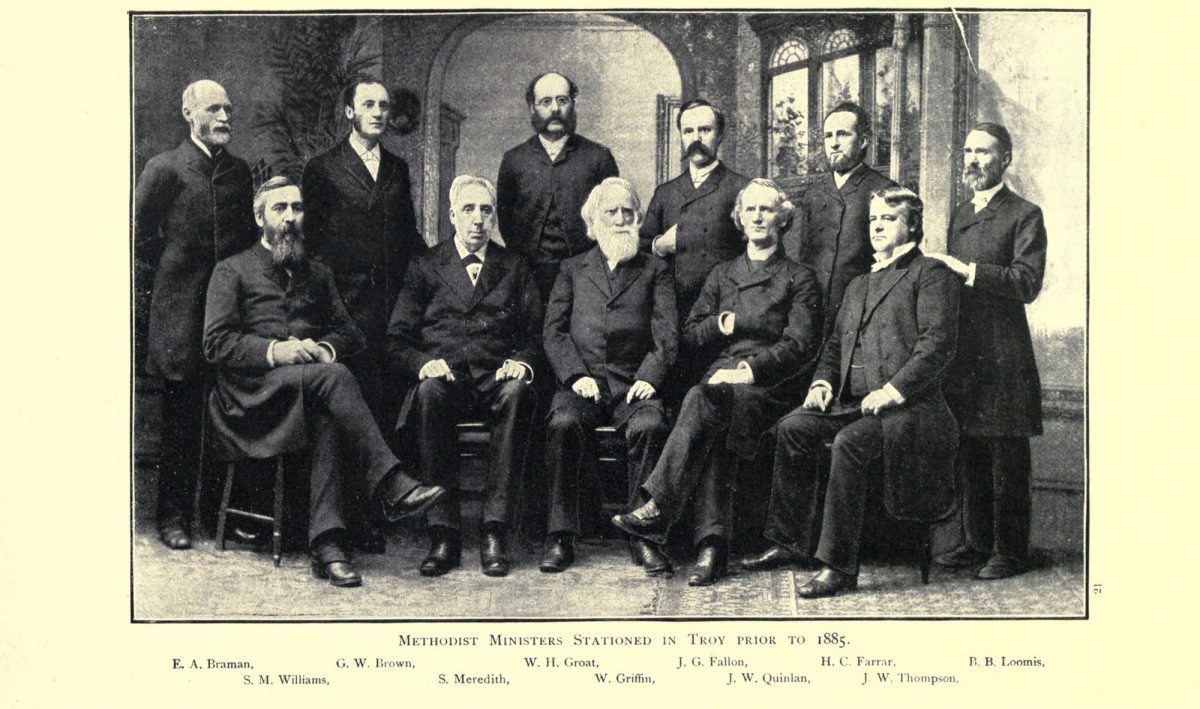
Samuel Meredith (1820-1894)
Rev. Samuel James Meredith was born on 1 Mar 1820 in Ireland. He was baptised on 16 Feb 1825 in Lea Parish, PortarlingtonG. He and Ellen Boomer were married on 3 May 1850 in Brookland, USA.2 He died on 16 Dec 1894, at age 74, in Stillwater, New YorkG.3 He was buried on 19 Dec 1894 in Menands Cemetery, Albany, New Yorks State.3
Samuel James Meredith was the eldest child of Richard Meredith and Anne Greene;. He emigrated to USA where he served as a Methodist minister. He lived in Williamsburgh, NY in 1850; Adams Township, Massachusetts in 1855; Clifton, NY in 1860; Albany, NY in 1870; Troy, NY in 1880. Baptism record transcribed as "James," born 1 March 1820 and is probably the same child as Samuel whose records are found in New York, said to have been born 9 March 1820.
In 1850 Samuel and his wife Ellen, aged 30 and 25, were living in Williamsburgh, Kings county, NY. As a Methodist clergyman, he evidently moved around a fair bit. Their first child Mary Ann was born ca 1851 in Ohio; the next child Richard B. ca March 1855 in Massachusetts (he was recorded as being 3 months old in the census taken on June 1), and the third, about 1858 in New York. In 1860 they were living in Clifton Park, Saratoga county, NY. 1870 finds them in Albany, NY, and in 1880 Samuel is a widower, living with George, Sophia and Martha in Troy, NY. Interestingly, this census indicates incorrectly, that his father was born in Wales. His obituary, published in the New York Times (18 Dec. 1894), notes he entered the ministry at the age of 17 and he had lived in Mansfield, Ohio for one year.
He served as Pastor in the following Methodist Episcopal Churches in Troy: Congress Street (Trinity) Church, 1872-73; North Second Street (Fifth Avenue) Church, 1873-76; Levings Chapel, 1879-82.
Excerpts from the Minutes of the Troy Conference, Methodist Episcopal Church provide the following information (1895, pp. 135-136):
“Samuel was born in Dublin, March 9, 1820. His parents were among the first Irish Wesleyans and his grandmother's house being the first place where a Wesleyan preached in that country, and because of which the house was nearly destroyed. The family came to NY in 1847. He married Eleanor Boomer in NY in 1850. Three of their six children were still living in 1895, George and two daughters. Both daughters were living in Stillwater, NY at the time; one was a Mrs. Carver.”
Photo of tombstone: Albany Rural Cemetery, Menands, Albany County, New York, USA: Plot: Section 71, Lot 15, Grave 3. Noted: Birth: Aug., 1820; Death: Dec. 16, 1894; New York, USA; Died of softening of the brain. Source is Albany Rural Cemetery records. Also named on tombstone: Eleanor Boomer Meredith (1824 - 1880); Mary A. Meredith Brownell (1851 - 1888); Sophie E. Meredith Carver (1853 - 1916); Richard Boomer Meredith (1855 - 1893); and Martha J. Meredith (1862 - 1905).
In 1850 Samuel and his wife Ellen, aged 30 and 25, were living in Williamsburgh, Kings county, NY. As a Methodist clergyman, he evidently moved around a fair bit. Their first child Mary Ann was born ca 1851 in Ohio; the next child Richard B. ca March 1855 in Massachusetts (he was recorded as being 3 months old in the census taken on June 1), and the third, about 1858 in New York. In 1860 they were living in Clifton Park, Saratoga county, NY. 1870 finds them in Albany, NY, and in 1880 Samuel is a widower, living with George, Sophia and Martha in Troy, NY. Interestingly, this census indicates incorrectly, that his father was born in Wales. His obituary, published in the New York Times (18 Dec. 1894), notes he entered the ministry at the age of 17 and he had lived in Mansfield, Ohio for one year.
He served as Pastor in the following Methodist Episcopal Churches in Troy: Congress Street (Trinity) Church, 1872-73; North Second Street (Fifth Avenue) Church, 1873-76; Levings Chapel, 1879-82.
Excerpts from the Minutes of the Troy Conference, Methodist Episcopal Church provide the following information (1895, pp. 135-136):
“Samuel was born in Dublin, March 9, 1820. His parents were among the first Irish Wesleyans and his grandmother's house being the first place where a Wesleyan preached in that country, and because of which the house was nearly destroyed. The family came to NY in 1847. He married Eleanor Boomer in NY in 1850. Three of their six children were still living in 1895, George and two daughters. Both daughters were living in Stillwater, NY at the time; one was a Mrs. Carver.”
Photo of tombstone: Albany Rural Cemetery, Menands, Albany County, New York, USA: Plot: Section 71, Lot 15, Grave 3. Noted: Birth: Aug., 1820; Death: Dec. 16, 1894; New York, USA; Died of softening of the brain. Source is Albany Rural Cemetery records. Also named on tombstone: Eleanor Boomer Meredith (1824 - 1880); Mary A. Meredith Brownell (1851 - 1888); Sophie E. Meredith Carver (1853 - 1916); Richard Boomer Meredith (1855 - 1893); and Martha J. Meredith (1862 - 1905).
Family
Children with Ellen Boomer b. ca. 1822, d. 3 Feb 1880
| 1. | Daughter | Mary Ann Meredith b. ca. 1851, d. 1888 |
| 2. | Son | Richard Boomer Meredith b. ca. 1856, d. 10 Apr 1893 |
| 3. | Son | George Lonking Meredith b. 3 Oct 1857, d. 7 Sep 1929 |
| 4. | Daughter | Sophia Eleanor Meredith b. ca. 1860, d. 1916 |
| 5. | Daughter | Martha Jane Meredith b. ca. 1863, d. 9 Oct 1905 |
Connections
| Family Line | Clonenagh Merediths |
| Relationship | 2nd great-grandson of Rice Meredith 3rd great-nephew of Mathias Meredith |
| Ancestral line | RichardD, SamuelC, Early Clonenagh MeredithsB, Rice MeredithA |
| Ancestral line | RichardC, SamuelB, Early Clonenagh MeredithsA |
| Lists | Clonenagh Emigration Clonenagh Merediths Profession - Clergy |
| Charts | Clonenagh box chart Clonenagh indented chart Rearymore box chart Rearymore indented chart |
| Interactive Pedigree |
TIMELINE: Year Age
- 1820Birth:1 Mar 1820 | Ireland
- 185030Marriage: | Ellen Boomer3 May 1850 | Brookland, USAAge: ~28Birth: ca. 1822 | Northern IrelandDeath: on 3 Feb 1880 | Levings Chapel, Troy, New York State, USA
- 185030His father Richard Meredith died on 3 Jun 1850 in New YorkG.
- 1851~31His daughter Mary Ann Meredith was born ca. 1851 in OhioG.
- 1856~36His son Richard Boomer Meredith was born ca. 1856 in Massachusetts, USAG.
- 185636His mother Anne Greene died on 29 Jun 1856 in Brooklyn, New YorkG.
- 185737His son George Lonking Meredith was born on 3 Oct 1857 in Keeseville, New York State, USAG.
- 1860~40His daughter Sophia Eleanor Meredith was born ca. 1860 in New York state.
- 1863~43His daughter Martha Jane Meredith was born ca. 1863 in Tomhannock, New York State.
- 188059His wife Ellen Boomer died on 3 Feb 1880 in Levings Chapel, Troy, New York State, USA.
- 1888~68His daughter Mary Ann Meredith died in 1888 in New YorkG.
- 189373His son Richard Boomer Meredith died on 10 Apr 1893 in Gloversville, New YorkG.
- 189474Death:16 Dec 1894 | Stillwater, New YorkG
- 1894Burial:19 Dec 1894 | Menands Cemetery, Albany, New Yorks State
Citations
- [S383] Sharon Haggerty, Website: Haggerty Ancestors and Related Families, http://winters-online.net/sharon-haggerty-db/
- [S1875] Marriage announcement: Meredith-Boomer; Newry Telegraph 30 May 1850, pg. 3
- [S1877] Menands, New York, Albany Rural Cemetery Burial Cards, 1791-2011. Ancestry.com [database on-line]
| Last Edited | 30 Sep 2024 |
Sarah Meredith1
F, #1434, b. September 1822, d. 19 January 1876
Parents
| Father | Richard Meredith b. ca. 1792, d. 3 Jun 1850 |
| Mother | Anne Greene b. 4 Apr 1799, d. 29 Jun 1856 |
Biography
Sarah Meredith was born in Sep 1822 in Ireland. She was baptised on 16 Jul 1825 in Lea Parish, PortarlingtonG. She and James Gray were married on 16 Oct 1841 in Maryborough Church, Co. Laois, Ireland. She died on 19 Jan 1876, at age 53, in Market Square, Roscrea, Tipperary, Ireland.2
Family
Children with James Gray b. ca. 1818, d. 8 Oct 1909
| 1. | Daughter | Elizabeth Catherine Gray b. 20 Mar 1843 |
| 2. | Son | Richard Gray b. 17 Jul 1844, d. 7 Jan 1898 |
| 3. | Son | John Samuel Gray b. 1 Nov 1845 |
| 4. | Son | James Gray b. 15 Mar 1847, d. 28 May 1901 |
| 5. | Son | Frederick Thomas Gray b. 22 Jul 1848 |
| 6. | Son | Henry Alexander (Harry) Gray b. ca. 1850, d. aft. 1930 |
| 7. | Daughter | Mary Ann Gray b. 1855, d. 1916 |
| 8. | Son | Robert Wallace Gray b. 1857 |
| 9. | Daughter | Sarah Gray b. 26 Mar 1859, d. 18 Feb 1941 |
| 10. | Daughter | Frances Ralph Gray b. 9 Jul 1861, d. 10 Nov 1935 |
Connections
| Family Line | Clonenagh Merediths |
| Relationship | 2nd great-granddaughter of Rice Meredith 3rd great-niece of Mathias Meredith |
| Ancestral line | RichardD, SamuelC, Early Clonenagh MeredithsB, Rice MeredithA |
| Ancestral line | RichardC, SamuelB, Early Clonenagh MeredithsA |
| Lists | Clonenagh Merediths |
| Charts | Clonenagh box chart Clonenagh indented chart Rearymore box chart Rearymore indented chart |
| Interactive Pedigree |
TIMELINE: Year Age
- 1822Birth:Sep 1822 | Ireland
- 184119Marriage: | James Gray16 Oct 1841 | Maryborough Church, Co. Laois, IrelandAge: ~23Birth: ca. 1818 | Exeter, Devon, EnglandGDeath: on 8 Oct 1909 | 21 Regent Street, Nottingham, England
- 184320Her daughter Elizabeth Catherine Gray was born on 20 Mar 1843 in Maryborough, Queen's Co., IrelandG.
- 184421Her son Richard Gray was born on 17 Jul 1844.
- 184523Her son John Samuel Gray was born on 1 Nov 1845.
- 184724Her son James Gray was born on 15 Mar 1847.
- 184825Her son Frederick Thomas Gray was born on 22 Jul 1848 in Queen's Co., IrelandG.
- 1850~28Her son Henry Alexander (Harry) Gray was born ca. 1850.
- 185027Her father Richard Meredith died on 3 Jun 1850 in New YorkG.
- 1855~33Her daughter Mary Ann Gray was born in 1855 in Ireland.
- 185633Her mother Anne Greene died on 29 Jun 1856 in Brooklyn, New YorkG.
- 1857~35Her son Robert Wallace Gray was born in 1857.
- 185936Her daughter Sarah Gray was born on 26 Mar 1859 in Roscrea, Co. Tipperary, IrelandG.
- 186138Her daughter Frances Ralph Gray was born on 9 Jul 1861 in Ireland.
- 187653Death:19 Jan 1876 | Market Square, Roscrea, Tipperary, Ireland
- 1909Her husband James Gray died on 8 Oct 1909 in 21 Regent Street, Nottingham, England.
Citations
- [S383] Sharon Haggerty, Website: Haggerty Ancestors and Related Families, http://winters-online.net/sharon-haggerty-db/
- [S1462] Irish Civil Records of Births, Marriages and Deaths, database: https://civilrecords.irishgenealogy.ie/
| Last Edited | 18 Jun 2024 |
Jane G. Meredith1
F, #1435, b. 30 January 1825, d. 14 June 1901
Parents
| Father | Richard Meredith b. ca. 1792, d. 3 Jun 1850 |
| Mother | Anne Greene b. 4 Apr 1799, d. 29 Jun 1856 |
Biography
Jane G. Meredith was born on 30 Jan 1825 in Ireland. She was baptised on 16 Jul 1825 in Lea Parish, PortarlingtonG. She and John M. Dawson were married. She died on 14 Jun 1901, at age 76, in Manhattan, New York, USAG.2 She was buried in Clinton Cemetery, New JerseyG.2
In the 1900 census Jane is said to have immigrated to the USA in 1848. It also states that she had given birth to 7 children, only one of whom was still living. She lived on 10th Avenue in Manhattan with her daughter Elizabeth.
Family
Children with John M. Dawson b. ca. 1816, d. 20 May 1886
| 1. | Son | John Wesley Dawson |
| 2. | Son | Richard Dawson |
| 3. | Daughter | Meredith Dawson |
| 4. | Daughter | Sarah Dawson |
| 5. | Daughter | Ann (Annie) Dawson b. ca. 1846, d. 26 Jun 1872 |
| 6. | Daughter | Elizabeth (Lizzie) Dawson b. Oct 1848 |
Connections
| Family Line | Clonenagh Merediths |
| Relationship | 2nd great-granddaughter of Rice Meredith 3rd great-niece of Mathias Meredith |
| Ancestral line | RichardD, SamuelC, Early Clonenagh MeredithsB, Rice MeredithA |
| Ancestral line | RichardC, SamuelB, Early Clonenagh MeredithsA |
| Lists | Clonenagh Emigration Clonenagh Merediths |
| Charts | Clonenagh box chart Clonenagh indented chart Rearymore box chart Rearymore indented chart |
| Interactive Pedigree |
TIMELINE: Year Age
- 1825Birth:30 Jan 1825 | Ireland
- 1846~21Her daughter Ann (Annie) Dawson was born ca. 1846.
- 184823Her daughter Elizabeth (Lizzie) Dawson was born in Oct 1848.
- 185025Her father Richard Meredith died on 3 Jun 1850 in New YorkG.
- 185631Her mother Anne Greene died on 29 Jun 1856 in Brooklyn, New YorkG.
- 187247Her daughter Ann (Annie) Dawson died on 26 Jun 1872.
- 188661Her husband John M. Dawson died on 20 May 1886 in Manhattan, New York, USAG.
- 190176Death:14 Jun 1901 | Manhattan, New York, USAG
Citations
- [S383] Sharon Haggerty, Website: Haggerty Ancestors and Related Families, http://winters-online.net/sharon-haggerty-db/
- [S1627] New York, New York City Municipal Deaths, 1795-1949, database, FamilySearch.org
| Last Edited | 11 Jan 2024 |
Maria Meredith1
F, #1436, b. 14 March 1827
Parents
| Father | Richard Meredith b. ca. 1792, d. 3 Jun 1850 |
| Mother | Anne Greene b. 4 Apr 1799, d. 29 Jun 1856 |
Biography
Maria Meredith was born on 14 Mar 1827 in Ireland. She was baptised on 29 Apr 1827 in Lea Parish, PortarlingtonG.
Connections
| Family Line | Clonenagh Merediths |
| Relationship | 2nd great-granddaughter of Rice Meredith 3rd great-niece of Mathias Meredith |
| Ancestral line | RichardD, SamuelC, Early Clonenagh MeredithsB, Rice MeredithA |
| Ancestral line | RichardC, SamuelB, Early Clonenagh MeredithsA |
| Lists | Clonenagh Merediths |
| Charts | Clonenagh box chart Clonenagh indented chart Rearymore box chart Rearymore indented chart |
| Interactive Pedigree |
TIMELINE: Year Age
- 1827Birth:14 Mar 1827 | Ireland
- 185023Her father Richard Meredith died on 3 Jun 1850 in New YorkG.
- 185629Her mother Anne Greene died on 29 Jun 1856 in Brooklyn, New YorkG.
Citations
- [S383] Sharon Haggerty, Website: Haggerty Ancestors and Related Families, http://winters-online.net/sharon-haggerty-db/
| Last Edited | 23 Apr 2017 |
Elizabeth Meredith1
F, #1437, b. 1829
Parents
| Father | Richard Meredith b. ca. 1792, d. 3 Jun 1850 |
| Mother | Anne Greene b. 4 Apr 1799, d. 29 Jun 1856 |
Biography
Elizabeth Meredith was born in 1829 in Ireland. She was baptised on 29 Mar 1829 in Lea Parish, PortarlingtonG. She and William Bramwell were married on 23 Oct 1850 in New York, USA.2
She was enumerated in the 1850 Census in New York. The Meredith household comprised Ann 30, Elizabeth 21, John 18, Frederick 14, Robert 12, Charlotte 10, and Emily 8.
Family
Children with William Bramwell b. Nov 1818
| 1. | Daughter | Anne Bramwell b. May 1852 |
| 2. | Son | William Bramwell b. ca. 1855 |
| 3. | Child | Forester Bramwell b. ca. 1857 |
| 4. | Son | John Edward (Edward) Bramwell b. Jan 1861 |
| 5. | Son | Samuel W. Bramwell b. Feb 1863, d. bef. 1920 |
| 6. | Daughter | Lillian Bramwell b. Jul 1867 |
| 7. | Daughter | Emily Grace? Bramwell b. ca. 1874 |
Connections
| Family Line | Clonenagh Merediths |
| Relationship | 2nd great-granddaughter of Rice Meredith 3rd great-niece of Mathias Meredith |
| Ancestral line | RichardD, SamuelC, Early Clonenagh MeredithsB, Rice MeredithA |
| Ancestral line | RichardC, SamuelB, Early Clonenagh MeredithsA |
| Lists | Clonenagh Emigration Clonenagh Merediths |
| Charts | Clonenagh box chart Clonenagh indented chart Rearymore box chart Rearymore indented chart |
| Interactive Pedigree |
TIMELINE: Year Age
- 1829Birth:1829 | Ireland
- 1850~21Her father Richard Meredith died on 3 Jun 1850 in New YorkG.
- 1850~21
- 1852~23Her daughter Anne Bramwell was born in May 1852.
- 1855~26Her son William Bramwell was born ca. 1855.
- 1856~27Her mother Anne Greene died on 29 Jun 1856 in Brooklyn, New YorkG.
- 1857~28Her child Forester Bramwell was born ca. 1857.
- 1861~32Her son John Edward (Edward) Bramwell was born in Jan 1861.
- 1863~34Her son Samuel W. Bramwell was born in Feb 1863.
- 1867~38Her daughter Lillian Bramwell was born in Jul 1867.
- 1874~45Her daughter Emily Grace? Bramwell was born ca. 1874.
Citations
- [S383] Sharon Haggerty, Website: Haggerty Ancestors and Related Families, http://winters-online.net/sharon-haggerty-db/
- [S1973] Marriage announcement: Bramwell - Meredith; email address Fibre Plus-Leinster Express 1831-current, Saturday, November 23, 1850; Page: 2-, “In New York, on the 23rd ultimo, by the Rev. Samuel Meredith, brother to the bride, Mr. William Bramwell, C.E., eldest son of Doctor Bramwell, of Liverpool, to Elizabeth, daughter of the late Richard Meredith, of Maryboro’.”
| Last Edited | 13 Jan 2024 |
John William Meredith1
M, #1438, b. 9 August 1830
Parents
| Father | Richard Meredith b. ca. 1792, d. 3 Jun 1850 |
| Mother | Anne Greene b. 4 Apr 1799, d. 29 Jun 1856 |
Biography
John William Meredith was born on 9 Aug 1830 in Ireland. He was baptised on 7 Nov 1830 in Lea Parish, PortarlingtonG. He and Anne Gray were married.
He was enumerated in the 1850 Census in New York, and described as a Coachmaker. The Meredith household comprised Ann 30, Elizabeth 21, John 18, Frederick 14, Robert 12, Charlotte 10, and Emily 8.
Family
Child with Anne Gray
| 1. | Daughter | Elizabeth Meredith |
Connections
| Family Line | Clonenagh Merediths |
| Relationship | 2nd great-grandson of Rice Meredith 3rd great-nephew of Mathias Meredith |
| Ancestral line | RichardD, SamuelC, Early Clonenagh MeredithsB, Rice MeredithA |
| Ancestral line | RichardC, SamuelB, Early Clonenagh MeredithsA |
| Lists | Clonenagh Emigration Clonenagh Merediths |
| Charts | Clonenagh box chart Clonenagh indented chart Rearymore box chart Rearymore indented chart |
| Interactive Pedigree |
TIMELINE: Year Age
- 1830Birth:9 Aug 1830 | Ireland
- 185019His father Richard Meredith died on 3 Jun 1850 in New YorkG.
- 185625His mother Anne Greene died on 29 Jun 1856 in Brooklyn, New YorkG.
Citations
- [S383] Sharon Haggerty, Website: Haggerty Ancestors and Related Families, http://winters-online.net/sharon-haggerty-db/
| Last Edited | 13 Jan 2024 |
Richard Thompson1
M, #1439, b. about 1845, d. 27 August 1901
Biography
Richard Thompson was born ca. 1845 in Ireland. He and Esther Meredith were married on 7 Sep 1875 in Mountrath Parish, Queen’s Co., Ireland.2 He died on 27 Aug 1901, at age ~56, in Srahane, Queen’s Co.2
Richard was a farmer in Shrahane at the time of his marriage. He was the son of Joseph Thompson.
Family
Children with Esther Meredith b. 8 Apr 1849, d. 16 Feb 1887
| 1. | Son | Joseph Thompson b. 22 Nov 1876 |
| 2. | Daughter | Mary Ellen Thompson b. 6 Apr 1878 |
| 3. | Son | Thomas Thompson b. 13 Sep 1879 |
| 4. | Daughter | Lydia Thompson b. 19 Aug 1881 |
Connections
| Family Line | Clonenagh Merediths |
| Relationship | Partner of Esther Meredith (2nd great-granddaughter of Rice Meredith) Partner of Esther Meredith (3rd great-niece of Mathias Meredith) |
| Lists | Clonenagh Merediths |
TIMELINE: Year Age
- 1845Birth:Ca. 1845 | Ireland
- 1875~30Marriage: | Esther Meredith7 Sep 1875 | Mountrath Parish, Queen’s Co., IrelandAge: 26Birth: on 8 Apr 1849 | The Oak, Queen's County, IrelandGDeath: on 16 Feb 1887 | Shrahane, Queen’s Co
- 1876~31His son Joseph Thompson was born on 22 Nov 1876 in Strahanboy, Queen’s Co., Ireland.
- 1878~33His daughter Mary Ellen Thompson was born on 6 Apr 1878 in Shrahanboy, Queen’s Co..
- 1879~34His son Thomas Thompson was born on 13 Sep 1879 in Shahanboy, Queen’s Co., Ireland.
- 1881~36His daughter Lydia Thompson was born on 19 Aug 1881 in Shrahane, Queen’s Co.
- 1887~42His wife Esther Meredith died on 16 Feb 1887 in Shrahane, Queen’s Co.
- 1901~56Death:27 Aug 1901 | Srahane, Queen’s Co.
Citations
- [S383] Sharon Haggerty, Website: Haggerty Ancestors and Related Families, http://winters-online.net/sharon-haggerty-db/
- [S1462] Irish Civil Records of Births, Marriages and Deaths, database: https://civilrecords.irishgenealogy.ie/
| Last Edited | 11 Sep 2018 |
George Bolton Meredith1
M, #1440, b. about 1834, d. 25 September 1906
Parents
| Father | John Meredith b. ca. 1800, d. bef. 1860 |
| Mother | Anne Bolton b. ca. 1800, d. ca. 1860 |
Biography
George Bolton Meredith was born ca. 1834 in Queen's Co., IrelandG. He and Martha Claxton were married on 23 Jun 1859 in Roskelton Parish, Queen's County, Ireland.2 He died on 25 Sep 1906, at age ~72, in Franklin, Parry Sound District, Ontario. He was buried in St. Paul's Anglican Church Cemetery, Muskoka.
George was a resident of Clondarrig, Clonenagh Parish, at the time of his marriage in 1859. This was the same time as Plot #1 in Clondarrig was passed from Anne Meredith to George Meredith. However, a year later the land passed to Representatives of Anne. George evidently emigrated to Canada at that time as he was enumerated in Essa tp, Simcoe county, Canada West (Ontario) in 1861: Essa Tp, Simcoe County: Div. 3, p. 27, line 31:?Miredeth, George, born Ireland, English Church, age 24, Male, Married [there were no others listed in the household, apparently George initially came to Canada alone and Martha followed after this census was recorded].?In 1871 George and his wife Martha lived in Tosorontio, Simcoe County: SIMCOE SOUTH, Sub-district: Tosorontio. Div: 2, p. 28; Microfilm reel: C-9961?MERIDETH , GEORGE: Male, 37, Birthplace: IRELAND, Religion: Church of England, Anglican, Farmer; Martha, 25, born Ireland; Robert, 8, born Canada; William, 7, born Canada; also in household Amelia Robinson, 45, born Ireland.?In the 1872 Gazeteer & Directory for Simcoe County, George Meredith is on Lot 3 of the1st Concession, not far from Thomas and Edward Meredith who were on Lot 2 of the 2nd (sons of John Meredith and Jane Wilkinson, presumed to be cousins of George).?In 1881 George is listed as a widower and he and his sons were in Sinclair & Franklin tp, Muskoka, Ontario, Film C-13243; District 131; Sub-district L; p. 12; household 55.?Name Marital Status Gender Ethnic Origin Age Birthplace Occupation Religion?George MEREDITH W Male Irish 46 Ireland Farmer Presbyterian?Robert MEREDITH Male Irish 18 O Farmer Presbyterian
William MEREDITH Male Irish 17 O Farmer Presbyterian?And in 1891 George is still a widower, age 59, farmer; Robert is 28; William is 26. Also in the household is William Shaw, 14, born Ontario. They are in the "Franklin, Sinclair and Chaffey subdistrict of Muskoka/Parry Sound" (film #T-6354, p. 3, line 12, family 10).?I was unable to find either George or Robert in the 1901 census. The death record is for George "Belton" Meredith in the Parry Sound district, born Ireland, age 75 years, 27 days; cause of death indigestion for 18 months (reg'n #22611-1906). Robert shows up in the 1911 census, still in the same area.?Burial record, Muskoka Cemeteries, Sinclair Township: St. Paul's Anglican Cemetery
Headstone reads: George B. Meredith, Died September 25th, 1906, Age 75 years, 29 days
I was sent a brief bio. of George taken from a local history book: "Hillside Pioneer Memorial United Church," a centennial history (the write-up includes a photo of George).
"George Meredith was born in 1831 in Queens County, Ireland & came to Canada in 1860 settling at Alliston, Essa Township, Simcoe County, Ontario. In about 1875 he & his wife Martha, and their two sons Robert & William came to locate land in Franklin Twp., Muskoka District. George was Master of LOL #418 at Cain's Corners in 1888 & 1889. Martha died sometime before 1891. Their son William was accidently killed in a hunting accident September 19, 1893. George was the secretary for the Hillside United Church & active as an assessor with the school section for many years. William Proudfoot, a Huntsville architect & builder was commissioned to drawings for the Meredith stone home, built in 1905 on the Portage Road. George died September 25, 1906 & his son Robert continued to live there until his death on May 17, 1922. George & his two sons are buried at Grassmere Cemetery [St. Paul's Anglican Church Cemetery].
"Robert Meredith bequeathed the farm to Tom Shaw who with his sister had come to live with the Meredith family as teenagers." Perhaps this was the same family as Wm Shaw found in the 1891 census.
William MEREDITH Male Irish 17 O Farmer Presbyterian?And in 1891 George is still a widower, age 59, farmer; Robert is 28; William is 26. Also in the household is William Shaw, 14, born Ontario. They are in the "Franklin, Sinclair and Chaffey subdistrict of Muskoka/Parry Sound" (film #T-6354, p. 3, line 12, family 10).?I was unable to find either George or Robert in the 1901 census. The death record is for George "Belton" Meredith in the Parry Sound district, born Ireland, age 75 years, 27 days; cause of death indigestion for 18 months (reg'n #22611-1906). Robert shows up in the 1911 census, still in the same area.?Burial record, Muskoka Cemeteries, Sinclair Township: St. Paul's Anglican Cemetery
Headstone reads: George B. Meredith, Died September 25th, 1906, Age 75 years, 29 days
I was sent a brief bio. of George taken from a local history book: "Hillside Pioneer Memorial United Church," a centennial history (the write-up includes a photo of George).
"George Meredith was born in 1831 in Queens County, Ireland & came to Canada in 1860 settling at Alliston, Essa Township, Simcoe County, Ontario. In about 1875 he & his wife Martha, and their two sons Robert & William came to locate land in Franklin Twp., Muskoka District. George was Master of LOL #418 at Cain's Corners in 1888 & 1889. Martha died sometime before 1891. Their son William was accidently killed in a hunting accident September 19, 1893. George was the secretary for the Hillside United Church & active as an assessor with the school section for many years. William Proudfoot, a Huntsville architect & builder was commissioned to drawings for the Meredith stone home, built in 1905 on the Portage Road. George died September 25, 1906 & his son Robert continued to live there until his death on May 17, 1922. George & his two sons are buried at Grassmere Cemetery [St. Paul's Anglican Church Cemetery].
"Robert Meredith bequeathed the farm to Tom Shaw who with his sister had come to live with the Meredith family as teenagers." Perhaps this was the same family as Wm Shaw found in the 1891 census.
For further information see the citations below.3
Family
Children with Martha Claxton b. ca. 1838, d. aft. 1874
| 1. | Son | Robert Meredith b. 13 Oct 1862, d. 17 May 1922 |
| 2. | Son | William Meredith b. ca. 1864, d. 19 Sep 1893 |
Connections
| Family Line | Clonenagh Merediths |
| Relationship | 2nd great-grandson of Rice Meredith 3rd great-nephew of Mathias Meredith |
| Ancestral line | JohnD, RiceC, Early Clonenagh MeredithsB, Rice MeredithA |
| Ancestral line | JohnC, RiceB, Early Clonenagh MeredithsA |
| Lists | Clonenagh Emigration Clonenagh Merediths |
| Charts | Clonenagh box chart Clonenagh indented chart Rearymore box chart Rearymore indented chart |
| Interactive Pedigree |
TIMELINE: Year Age
- 1834Birth:Ca. 1834 | Queen's Co., IrelandG
- 1859~25
- 1860His father John Meredith died bef. 1860.
- 1860~26His mother Anne Bolton died ca. 1860 in Queen's Co., IrelandG.
- 1862~28His son Robert Meredith was born on 13 Oct 1862 in Simcoe County, Ontario, CanadaG.
- 1864~30His son William Meredith was born ca. 1864 in Essa Township, Simcoe County, OntarioG.
- 1874His wife Martha Claxton died aft. 1874.
- 1893~59His son William Meredith died on 19 Sep 1893 in Parry Sound, Muskoka, Ontario.
- 1906~72Death:25 Sep 1906 | Franklin, Parry Sound District, Ontario
Citations
- [S383] Sharon Haggerty, Website: Haggerty Ancestors and Related Families, http://winters-online.net/sharon-haggerty-db/
- [S623] Roskelton 1845 Parish Register, records extracted by EJeffers
- [S490] Private communication from Susan Evans
| Last Edited | 10 Jan 2024 |
Martha Claxton1
F, #1441, b. about 1838, d. after 1874
Biography
Martha Claxton was born ca. 1838 in Ireland. She and George Bolton Meredith were married on 23 Jun 1859 in Roskelton Parish, Queen's County, Ireland.2 She died aft. 1874.
Family
Children with George Bolton Meredith b. ca. 1834, d. 25 Sep 1906
| 1. | Son | Robert Meredith b. 13 Oct 1862, d. 17 May 1922 |
| 2. | Son | William Meredith b. ca. 1864, d. 19 Sep 1893 |
Connections
| Family Line | Clonenagh Merediths |
| Relationship | Partner of George Bolton Meredith (2nd great-grandson of Rice Meredith) Partner of George Bolton Meredith (3rd great-nephew of Mathias Meredith) |
| Lists | Clonenagh Merediths |
| Charts | Clonenagh box chart Clonenagh indented chart Rearymore box chart Rearymore indented chart |
| Interactive Pedigree |
TIMELINE: Year Age
- 1838Birth:Ca. 1838 | Ireland
- 1859~21Marriage: | George Bolton Meredith23 Jun 1859 | Roskelton Parish, Queen's County, IrelandAge: ~25Birth: ca. 1834 | Queen's Co., IrelandGDeath: on 25 Sep 1906 | Franklin, Parry Sound District, Ontario
- 1862~24Her son Robert Meredith was born on 13 Oct 1862 in Simcoe County, Ontario, CanadaG.
- 1864~26Her son William Meredith was born ca. 1864 in Essa Township, Simcoe County, OntarioG.
- 1874Death:Aft. 1874
- 1906Her husband George Bolton Meredith died on 25 Sep 1906 in Franklin, Parry Sound District, Ontario.
Citations
- [S383] Sharon Haggerty, Website: Haggerty Ancestors and Related Families, http://winters-online.net/sharon-haggerty-db/
- [S623] Roskelton 1845 Parish Register, records extracted by EJeffers
| Last Edited | 21 Apr 2017 |
John Meredith1
M, #1442, b. about 1800, d. before 1860
Parents
| Father | Rice Meredith b. bef. 1780, d. Apr 1823 |
| Mother | Anne Neill b. bef. 1780 |
Biography
John Meredith was born ca. 1800 in Ireland. He was baptised on 25 Mar 1800 in Maryborough, Queen's Co., IrelandG.2 He and Anne Bolton were married in 1826 in Diocese of Ossory, Leinster Province, Ireland.3 He died bef. 1860.
John is the first child of Rice and Ann recorded in the parish register--there may have been older children as there were only fragmentary records prior to this date (Register 1793 - 1825, p. 4). He is believed to have been the John Meredith who married Anne Bolton in 1826 (MLB, Diocese of Ossory, IGI), although we have no firm documentation for this. Similarly, not documented that he is the John whose son George married Martha Claxton, but George was from Clondarrig when he married. No other known John seems to be the right age and in 1850 in the Griffiths Valuation an Anne Meredith holds land in Clondarrig, home of Rice and Anne Neill, which was briefly held by a George Meredith. A John Meredith of "Clondarrigmoyle" was registered as a voter in Maryborough East 5 January 1841--probably this man. We have not been able to identify any parish records for this branch of the family other than those indicated. Hence, these relationships are somewhat speculative, but are supported by the finding of a Canadian death registration for son of George giving his full name as "George Belton Meredith."
Family
Child with Anne Bolton b. ca. 1800, d. ca. 1860
| 1. | Son | George Bolton Meredith b. ca. 1834, d. 25 Sep 1906 |
Connections
| Family Line | Clonenagh Merediths |
| Relationship | Great-grandson of Rice Meredith 2nd great-nephew of Mathias Meredith |
| Ancestral line | RiceC, Early Clonenagh MeredithsB, Rice MeredithA |
| Ancestral line | RiceB, Early Clonenagh MeredithsA |
| Lists | Clonenagh Merediths |
| Charts | Clonenagh box chart Clonenagh indented chart Rearymore box chart Rearymore indented chart |
| Interactive Pedigree |
TIMELINE: Year Age
- 1800Birth:Ca. 1800 | Ireland
- 1823~23His father Rice Meredith died in Apr 1823.
- 1826~26
- 1834~34His son George Bolton Meredith was born ca. 1834 in Queen's Co., IrelandG.
- 1860Death:Bef. 1860
- 1860His wife Anne Bolton died ca. 1860 in Queen's Co., IrelandG.
Citations
- [S383] Sharon Haggerty, Website: Haggerty Ancestors and Related Families, http://winters-online.net/sharon-haggerty-db/
- [S437] Parish Register (1793-1825, #P0799-011), Maryborough, Queens County, Ireland
- [S69] IGI - International Genealogical Index; https://familysearch.org/search/collection/igi
| Last Edited | 21 Apr 2017 |
Mary Anne Alexander1
F, #1443, b. about 1827, d. 2 October 1891
Parents
| Father | John Alexander |
Biography
Mary Anne Alexander was born ca. 1827 in Ireland. She and Richard Meredith were married on 9 Sep 1848 in Geashill, King’s Co., IrelandG.2 She and William Strong were married on 11 Aug 1859 in Roskelton Parish, Queen's County, Ireland.3 She died on 2 Oct 1891, at age ~64, in Cappagh, Queen’s County, Ireland.4
She was the daughter of John Alexander, according to the certificate of her 2nd marriage.
Families
Children with Richard Meredith b. ca. 1807, d. 1855
| 1. | Daughter | Anne Meredith b. ca. 1850, d. 7 Jun 1933 |
| 2. | Son | Alexander Meredith b. 13 Jul 1854, d. 24 Jul 1931 |
| 3. | Son | Richard William Meredith b. 4 Apr 1856, d. 4 Jan 1912 |
Children with William Strong b. ca. 1828, d. 10 Apr 1881
| 1. | Son | William Strong b. ca. 1861, d. 7 Mar 1931 |
| 2. | Son | John Strong b. ca. 1863, d. 3 Nov 1934 |
| 3. | Son | Elijah Strong b. 21 Jan 1865, d. 1865 |
| 4. | Daughter | Lucinda Strong b. 16 Jan 1867, d. 25 Dec 1930 |
| 5. | Daughter | Susanna Strong b. 7 Nov 1868 |
| 6. | Daughter | Rebecca Evelyn Strong b. 21 Dec 1870, d. 25 Sep 1953 |
Connections
| Family Line | Clonenagh Merediths |
| Relationship | Partner of Richard Meredith (great-grandson of Rice Meredith) Partner of Richard Meredith (2nd great-nephew of Mathias Meredith) |
| Lists | Clonenagh Merediths |
| Charts | Clonenagh box chart Clonenagh indented chart Rearymore box chart Rearymore indented chart |
| Interactive Pedigree |
TIMELINE: Year Age
- 1827Birth:Ca. 1827 | Ireland
- 1848~21Marriage: | Richard Meredith9 Sep 1848 | Geashill, King’s Co., IrelandG
- 1850~23Her daughter Anne Meredith was born ca. 1850.
- 1854~27Her son Alexander Meredith was born on 13 Jul 1854 in Maryborough, Queen's Co., IrelandG.
- 1855~28Her husband Richard Meredith died in 1855 in Cappagh, Queens County.
- 1856~29Her son Richard William Meredith was born on 4 Apr 1856 in Cappagh, Queen's County, Ireland.
- 1859~32
- 1861~34Her son William Strong was born ca. 1861 in Cappagh.
- 1863~36Her son John Strong was born ca. 1863.
- 1865~38Her son Elijah Strong died in 1865 in Mountmellick, Queen’s Co., IrelandG.
- 1865~38Her son Elijah Strong was born on 21 Jan 1865 in Cappagh.
- 1867~40Her daughter Lucinda Strong was born on 16 Jan 1867 in Cappagh.
- 1868~41Her daughter Susanna Strong was born on 7 Nov 1868 in Cappagh.
- 1870~43Her daughter Rebecca Evelyn Strong was born on 21 Dec 1870 in Cappagh.
- 1881~54Her husband William Strong died on 10 Apr 1881 in Cappagh, Queen’s County, Ireland.
- 1891~64Death:2 Oct 1891 | Cappagh, Queen’s County, Ireland
Citations
- [S383] Sharon Haggerty, Website: Haggerty Ancestors and Related Families, http://winters-online.net/sharon-haggerty-db/
- [S69] IGI - International Genealogical Index; https://familysearch.org/search/collection/igi
- [S465] Parish register
- [S492] Death certificate of Mary Anne Strong, 2 Oct 1891, Mountmellick Registration District; copy in the possession of the author
| Last Edited | 3 Dec 2019 |
William Strong1
M, #1444, b. about 1828, d. 10 April 1881
Parents
| Father | William Strong b. ca. 1785, d. ca. 1857 |
| Mother | Margaret b. ca. 1798, d. 18 Nov 1873 |
Biography
William Strong was born ca. 1828.2 He and Mary Anne Alexander were married on 11 Aug 1859 in Roskelton Parish, Queen's County, Ireland.3 He died on 10 Apr 1881, at age ~53, in Cappagh, Queen’s County, Ireland.4
In 1860 William Strong became the landholder of Block #5 in Cappagh, formerly held by the late husband (Richard Meredith) of his wife, Maryanne. In 1906 Mary Anne Strong became the registered holder of Block 5.
For further information see the citations below.2
Family
Children with Mary Anne Alexander b. ca. 1827, d. 2 Oct 1891
| 1. | Son | William Strong b. ca. 1861, d. 7 Mar 1931 |
| 2. | Son | John Strong b. ca. 1863, d. 3 Nov 1934 |
| 3. | Son | Elijah Strong b. 21 Jan 1865, d. 1865 |
| 4. | Daughter | Lucinda Strong b. 16 Jan 1867, d. 25 Dec 1930 |
| 5. | Daughter | Susanna Strong b. 7 Nov 1868 |
| 6. | Daughter | Rebecca Evelyn Strong b. 21 Dec 1870, d. 25 Sep 1953 |
Connections
| Family Line | Clonenagh Merediths |
| Lists | Clonenagh Merediths |
| Interactive Pedigree |
TIMELINE: Year Age
- 1828Birth:Ca. 1828
- 1857~29His father William Strong died ca. 1857 in Shanbeg, Co. Laois, IrelandG.
- 1859~31Marriage: | Mary Anne Alexander11 Aug 1859 | Roskelton Parish, Queen's County, IrelandAge: ~32Birth: ca. 1827 | IrelandDeath: on 2 Oct 1891 | Cappagh, Queen’s County, Ireland
- 1861~33His son William Strong was born ca. 1861 in Cappagh.
- 1863~35His son John Strong was born ca. 1863.
- 1865~37His son Elijah Strong died in 1865 in Mountmellick, Queen’s Co., IrelandG.
- 1865~37His son Elijah Strong was born on 21 Jan 1865 in Cappagh.
- 1867~39His daughter Lucinda Strong was born on 16 Jan 1867 in Cappagh.
- 1868~40His daughter Susanna Strong was born on 7 Nov 1868 in Cappagh.
- 1870~42His daughter Rebecca Evelyn Strong was born on 21 Dec 1870 in Cappagh.
- 1873~45
- 1881~53Death:10 Apr 1881 | Cappagh, Queen’s County, Ireland
- 1891His wife Mary Anne Alexander died on 2 Oct 1891 in Cappagh, Queen’s County, Ireland.
Citations
- [S383] Sharon Haggerty, Website: Haggerty Ancestors and Related Families, http://winters-online.net/sharon-haggerty-db/, marriage entry in Roskelton parish register states that he was from Rosenallis, son of William Strong
- [S383] Sharon Haggerty, Website: Haggerty Ancestors and Related Families, http://winters-online.net/sharon-haggerty-db/
- [S465] Parish register
- [S494] Death certificate of William Strong, 10 April 1881, Mountmellick Registration District; copy in the possession of the author
| Last Edited | 8 Apr 2020 |
Eliza (Elizabeth) Meredith1
F, #1445, d. 26 January 1898
Parents
| Father | Thomas Meredith b. ca. 1805, d. 1890 |
| Mother | Rebecca Pattison b. 1 Feb 1805, d. 28 Aug 1894 |
Biography
Eliza (Elizabeth) Meredith was born in Cappagh, Clonenagh Parish, Queens County, Ireland. She was baptised on 10 May 1835 in Ballyfin, Clonenagh Parish.2 She and William Cobbe were married on 3 May 1865 in Mountrath, Queen’s Co., IrelandG.3 She died on 26 Jan 1898 in Morett, Queen's Co., IrelandG.4 She was buried in Coolbanagher churchyard.5
Family
Children with William Cobbe b. 1808, d. 9 May 1899
| 1. | Son | Thomas Cobbe b. 30 Jul 1872, d. 31 May 1932 |
| 2. | Daughter | Rebecca Cobbe b. 1873 |
| 3. | Daughter | Susanna Cobbe b. 27 May 1874 |
| 4. | Son | John Cobbe b. 1875 |
| 5. | Daughter | Sarah Cobbe b. 1876 |
| 6. | Son | William Cobbe b. 14 May 1876 |
Connections
| Family Line | Clonenagh Merediths |
| Relationship | 2nd great-granddaughter of Rice Meredith 3rd great-niece of Mathias Meredith |
| Ancestral line | ThomasD, RiceC, Early Clonenagh MeredithsB, Rice MeredithA |
| Ancestral line | ThomasC, RiceB, Early Clonenagh MeredithsA |
| Lists | Clonenagh Merediths |
| Charts | Clonenagh box chart Clonenagh indented chart Rearymore box chart Rearymore indented chart Wilkinson box chart Wilkinson indented chart |
| Interactive Pedigree |
TIMELINE: Year Age
- 1865
- 1872Her son Thomas Cobbe was born on 30 Jul 1872 in Morett, Queen's Co., IrelandG.
- 1873Her daughter Rebecca Cobbe was born in 1873 in Queen's Co., IrelandG.
- 1874Her daughter Susanna Cobbe was born on 27 May 1874 in Morett, Queen's Co., IrelandG.
- 1875Her son John Cobbe was born in 1875 in Queen's Co., IrelandG.
- 1876Her daughter Sarah Cobbe was born in 1876 in Queen's Co., IrelandG.
- 1876Her son William Cobbe was born on 14 May 1876 in Morett, Queen's Co., IrelandG.
- 1890Her father Thomas Meredith died in 1890.
- 1894Her mother Rebecca Pattison died on 28 Aug 1894 in Queen's Co., IrelandG.
- 1898Death:26 Jan 1898 | Morett, Queen's Co., IrelandG
- 1899Her husband William Cobbe died on 9 May 1899 in Queen's Co., IrelandG.
Citations
- [S383] Sharon Haggerty, Website: Haggerty Ancestors and Related Families, http://winters-online.net/sharon-haggerty-db/
- [S430] Ballyfin 1821 Parish Register, RCBL #P0859.01
- [S447] Mountrath 1837 Parish Register, Clonenagh Parish, records extracted by EJeffers.
- [S1462] Irish Civil Records of Births, Marriages and Deaths, database: https://civilrecords.irishgenealogy.ie/
- [S495] Private communication from Patricia Cobbe
| Last Edited | 21 Apr 2017 |
William Cobbe1
M, #1446, b. 1808, d. 9 May 1899
Biography
William Cobbe was born in 1808 in Ireland. He and Eliza (Elizabeth) Meredith were married on 3 May 1865 in Mountrath, Queen’s Co., IrelandG.2 He died on 9 May 1899, at age ~91, in Queen's Co., IrelandG. He was buried in Coolbanagher churchyard.
For further information see the citations below.3
Family
Children with Eliza (Elizabeth) Meredith d. 26 Jan 1898
| 1. | Son | Thomas Cobbe b. 30 Jul 1872, d. 31 May 1932 |
| 2. | Daughter | Rebecca Cobbe b. 1873 |
| 3. | Daughter | Susanna Cobbe b. 27 May 1874 |
| 4. | Son | John Cobbe b. 1875 |
| 5. | Daughter | Sarah Cobbe b. 1876 |
| 6. | Son | William Cobbe b. 14 May 1876 |
Connections
| Family Line | Clonenagh Merediths |
| Relationship | Partner of Eliza (Elizabeth) Meredith (2nd great-granddaughter of Rice Meredith) Partner of Eliza (Elizabeth) Meredith (3rd great-niece of Mathias Meredith) |
| Lists | Clonenagh Merediths Late Deaths aged 90 and above |
| Charts | Clonenagh box chart Clonenagh indented chart Rearymore box chart Rearymore indented chart Wilkinson box chart Wilkinson indented chart |
| Interactive Pedigree |
TIMELINE: Year Age
- 1808Birth:1808 | Ireland
- 1865~57Marriage: | Eliza (Elizabeth) Meredith3 May 1865 | Mountrath, Queen’s Co., IrelandGBirth: | Cappagh, Clonenagh Parish, Queens County, IrelandDeath: on 26 Jan 1898 | Morett, Queen's Co., IrelandG
- 1872~64His son Thomas Cobbe was born on 30 Jul 1872 in Morett, Queen's Co., IrelandG.
- 1873~65His daughter Rebecca Cobbe was born in 1873 in Queen's Co., IrelandG.
- 1874~66His daughter Susanna Cobbe was born on 27 May 1874 in Morett, Queen's Co., IrelandG.
- 1875~67His son John Cobbe was born in 1875 in Queen's Co., IrelandG.
- 1876~68His daughter Sarah Cobbe was born in 1876 in Queen's Co., IrelandG.
- 1876~68His son William Cobbe was born on 14 May 1876 in Morett, Queen's Co., IrelandG.
- 1898~90His wife Eliza (Elizabeth) Meredith died on 26 Jan 1898 in Morett, Queen's Co., IrelandG.
- 1899~91Death:9 May 1899 | Queen's Co., IrelandG
Citations
- [S383] Sharon Haggerty, Website: Haggerty Ancestors and Related Families, http://winters-online.net/sharon-haggerty-db/
- [S447] Mountrath 1837 Parish Register, Clonenagh Parish, records extracted by EJeffers.
- [S495] Private communication from Patricia Cobbe
| Last Edited | 21 Apr 2017 |
John Wilkinson
M, #1447, b. about 1857, d. 23 December 1948
Parents
| Father | Edward Wilkinson b. ca. 1822, d. 1 May 1882 |
| Mother | Eliza Meredith b. ca. 1831, d. 29 Oct 1916 |
Biography
John Wilkinson was born ca. 1857 in Queen's Co., IrelandG.1 He and Margaret Susanna Meredith were married on 10 Jul 1890 in Coolbanagher Parish Church, Queen’s County.2,3 He died on 23 Dec 1948, at age ~91, in Athy, Co. Kildare, IrelandG.4
John Wilkinson was the son of Edward Wilkinson, who is believed to be the Edward who married Eliza Meredith and who was living at Ballyadams in 1882. John was a farmer living at Ballyadams at the time of his marriage in 1890. He was recorded in the 1901 census as head of household at Monascreeban, Ballyadams, Queen’s County with his wife Margaret, daughter Elizabeth, son Edward, nephew Thomas Meredith, a nurse domestic servant and 32 farm servants. He was enumerated in the 1911 census at Monascreeban, Ballyadams, Queen’s County, and described as a Farmer, aged 54, Church of Ireland. In the same household were: Margaret Wilkinson (wife, 49), Lizzabeth Wilkinson (daughter 18), Edward Wilkinson (son, 10), Violet Mathers (visitor, 15) and Edward Holahan (servant, 27). He was known as “Happy John” Wilkinson.3,5,1
Family
Children with Margaret Susanna Meredith b. 31 May 1862, d. 26 Aug 1951
| 1. | Daughter | Elizabeth Caroline Wilkinson b. 11 Jul 1892 |
| 2. | Son | Edward Thomas Wilkinson b. 20 Dec 1900, d. 9 Jun 1928 |
Connections
| Family Line | Clonenagh Merediths |
| Relationship | 3rd great-grandson of Rice Meredith 4th great-nephew of Mathias Meredith |
| Ancestral line | Eliza MeredithE, SamuelD, ThomasC, Early Clonenagh MeredithsB, Rice MeredithA |
| Ancestral line | Eliza MeredithD, SamuelC, ThomasB, Early Clonenagh MeredithsA |
| Lists | Clonenagh Merediths Late Deaths aged 90 and above |
TIMELINE: Year Age
- 1857Birth:Ca. 1857 | Queen's Co., IrelandG
- 1882~25His father Edward Wilkinson died on 1 May 1882 in Monaseribban, Ireland.
- 1890~33Marriage: | Margaret Susanna Meredith10 Jul 1890 | Coolbanagher Parish Church, Queen’s CountyJohn Wilkinson and Margaret Susanna Meredith were married on 10 Jul 1890 in Coolbanagher Parish Church, Queen’s County.
- 1892~35His daughter Elizabeth Caroline Wilkinson was born on 11 Jul 1892 in Ballyadams, IrelandG.
- 1900~43His son Edward Thomas Wilkinson was born on 20 Dec 1900 in Monaseribban, Ireland.
- 1916~59His mother Eliza Meredith died on 29 Oct 1916.
- 1928~71His son Edward Thomas Wilkinson died on 9 Jun 1928 in Ballyadams, Co. Laois, IrelandG.
- 1948~91Death:23 Dec 1948 | Athy, Co. Kildare, IrelandG
- 1951His wife Margaret Susanna Meredith died on 26 Aug 1951 in Athy, Co. Kildare, IrelandG.
Citations
- [S599] 1911 Census of Ireland online http://www.census.nationalarchives.ie/pages/1911/Queen_s_Co_/Kilcolmbane/Ballycarnan/791674/ accessed Nov 2009
- [S605] Family Search, Record Search - Pilot Site, http://pilot.familysearch.org/recordsearch/ accessed Jul 2009
- [S1033] Marriage certificate: John Wilkinson and Margaret Susanna Meredith, 10 July 1890, Coolbanagher Parish Church, Queen’s County, Ireland; copy in the possession of the author
- [S1462] Irish Civil Records of Births, Marriages and Deaths, database: https://civilrecords.irishgenealogy.ie/
- [S1048] National Archives of Ireland, http://www.census.nationalarchives.ie/pages/1911/Kildare/Kilkea/Ballynamony/536999/
| Last Edited | 22 Sep 2016 |
Mary Ella Collinge
F, #1448, b. 3 June 1891
Parents
| Father | Percy Thaddeus Collinge b. 1864, d. 1899 |
| Mother | Esther Ellen Meredith b. 24 Feb 1863, d. 6 May 1912 |
Biography
Mary Ella Collinge was born on 3 Jun 1891 in Manitoba.1
For further information see the citations below.2
Connections
| Family Line | Clonenagh Merediths |
| Relationship | 4th great-granddaughter of Rice Meredith 5th great-niece of Mathias Meredith |
| Ancestral line | Esther Ellen MeredithF, RichardE, WilliamD, ThomasC, Early Clonenagh MeredithsB, Rice MeredithA |
| Ancestral line | Esther Ellen MeredithE, RichardD, WilliamC, ThomasB, Early Clonenagh MeredithsA |
| Lists | Clonenagh Merediths |
| Charts | Clonenagh box chart Clonenagh indented chart Rearymore box chart Rearymore indented chart |
| Interactive Pedigree |
TIMELINE: Year Age
- 1891Birth:3 Jun 1891 | Manitoba
- 1899~8Her father Percy Thaddeus Collinge died in 1899 in Manitoba.
- 191220Her mother Esther Ellen Meredith died on 6 May 1912 in Victoria, British Columbia, CanadaG.
Citations
- [S407] 1901 census, 1901 Census of Canada
- [S383] Sharon Haggerty, Website: Haggerty Ancestors and Related Families, http://winters-online.net/sharon-haggerty-db/
| Last Edited | 16 Aug 2006 |
Emeretta Meredith Collinge
F, #1449, b. 7 November 1893
Parents
| Father | Percy Thaddeus Collinge b. 1864, d. 1899 |
| Mother | Esther Ellen Meredith b. 24 Feb 1863, d. 6 May 1912 |
Biography
Emeretta Meredith Collinge was born on 7 Nov 1893 in Manitoba.1 She and Benjamin Alfred Ephraim Smith were married on 4 May 1916 in Victoria, British Columbia, CanadaG.
For further information see the citations below.2
Connections
| Family Line | Clonenagh Merediths |
| Relationship | 4th great-granddaughter of Rice Meredith 5th great-niece of Mathias Meredith |
| Ancestral line | Esther Ellen MeredithF, RichardE, WilliamD, ThomasC, Early Clonenagh MeredithsB, Rice MeredithA |
| Ancestral line | Esther Ellen MeredithE, RichardD, WilliamC, ThomasB, Early Clonenagh MeredithsA |
| Lists | Clonenagh Merediths |
| Charts | Clonenagh box chart Clonenagh indented chart Rearymore box chart Rearymore indented chart |
| Interactive Pedigree |
TIMELINE: Year Age
- 1893Birth:7 Nov 1893 | Manitoba
- 1899~6Her father Percy Thaddeus Collinge died in 1899 in Manitoba.
- 191218Her mother Esther Ellen Meredith died on 6 May 1912 in Victoria, British Columbia, CanadaG.
- 191622
- 192026Her husband Benjamin Alfred Ephraim Smith died in Feb 1920.
Citations
- [S407] 1901 census, 1901 Census of Canada
- [S383] Sharon Haggerty, Website: Haggerty Ancestors and Related Families, http://winters-online.net/sharon-haggerty-db/
| Last Edited | 11 Jan 2017 |
Elizabeth Bulfin
F, #1450, b. about 1853, d. after 1911
Biography
Elizabeth Bulfin was born ca. 1853 in Parsonstown, King’s CountyG.1 She and Thomas Meredith were married on 26 Dec 1879 in Mountrath Parish, Queen’s Co., Ireland.2 She died aft. 1911.
She was enumerated in the 1911 census as a Grocer’s widow, of Maryborough, aged 69.
For further information see the citations below.3
Connections
| Family Line | Clonenagh Merediths |
| Relationship | Partner of Thomas Meredith (2nd great-grandson of Rice Meredith) Partner of Thomas Meredith (3rd great-nephew of Mathias Meredith) |
| Lists | Clonenagh Merediths |
| Charts | Clonenagh box chart Clonenagh indented chart Rearymore box chart Rearymore indented chart |
| Interactive Pedigree |
TIMELINE: Year Age
- 1853Birth:Ca. 1853 | Parsonstown, King’s CountyG
- 1879~26Marriage: | Thomas Meredith26 Dec 1879 | Mountrath Parish, Queen’s Co., Ireland
- 1902~49Her husband Thomas Meredith died on 18 Mar 1902 in Green Road, MaryboroughG.
- 1911Death:Aft. 1911
Citations
- [S777] National Archives of Ireland, 1901 Census, 1901 Census of Ireland
- [S465] Parish register
- [S383] Sharon Haggerty, Website: Haggerty Ancestors and Related Families, http://winters-online.net/sharon-haggerty-db/
| Last Edited | 10 Mar 2018 |